
Last updated: August 2026. Reviewed by Maksim Grinvald, owner, Max Appliance Repair Sarasota.
In this article
Standing water at the bottom of your washing machine drum at the end of a cycle is one of the more unpleasant appliance problems to come home to. If you’re a homeowner dealing with a washer that will not drain, our team has been fixing washers in Sarasota for years, and can help. But before you call, there are several things worth checking yourself, with some of them taking under five minutes and cost nothing.
This guide covers the most common causes of a washer that will not drain, what you can try at home, and when the problem requires a professional repair.
How to Tell Your Washer is not Draining Properly
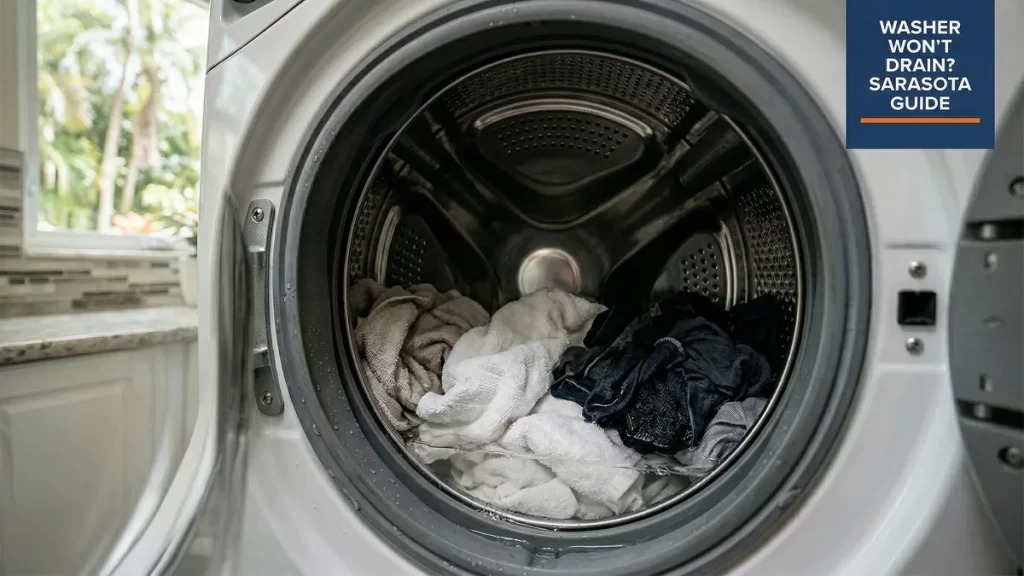
The obvious sign is standing water in the drum after the cycle ends. But a partial drain failure is more subtle. Your clothes feel heavier than normal after the spin cycle, the drum still has moisture on the walls, or the machine takes significantly longer than usual. Some homeowners notice a mildew smell developing faster than before, which is a sign of residual water sitting in the machine.
People often ask: why does my washing machine smell musty even after cleaning?
In Gulf Coast humidity, residual water in a washer that is not draining fully creates ideal conditions for mold and mildew to grow in the door boot, detergent drawer, and drum gasket. The fix starts with solving the drainage problem, then cleaning the machine with a washer cleaner tablet and leaving the door open between cycles to let moisture escape.
Simple Fixes You Can Try
- Check the drain hose. The drain hose connects the back of your washer to the standpipe or utility sink drain. It should have a loop that sits no higher than 96 inches from the floor per manufacturer guidelines. If it is too low, water siphons back in. If it is kinked or clogged with lint, water cannot get out.
- Check the drain hose end for a clog. Disconnect the hose from the standpipe and see if water drains freely when you run a short cycle. If it does, the standpipe is the problem, not the washer.
- Clean the pump filter (front-loaders). Front-loading washers have a small access door at the bottom front, usually behind a panel. Inside is a coin trap or pump filter that catches small items, lint, and debris. In homes with pets or sandy laundry, this fills up fast. Unscrew it over a towel, clean it out, and replace it. This fixes a surprising number of drain failures.
- Check the lid switch (top-loaders). On top-loading machines, the lid switch tells the machine the lid is closed before it will spin and drain. If the switch is broken, the machine will wash but not drain or spin. Press the switch manually with a pen. You should hear a click. No click means a failed switch.
- Run a spin-only cycle. If water drains during the spin cycle but not the normal drain cycle, the issue is likely a door latch or cycle selector problem, not a pump failure.
When it is the Drain Pump
If none of the above steps fix it, the drain pump itself is the most likely culprit. The pump is what physically moves water out of the drum and through the hose. Symptoms of a failed pump, you can hear a humming noise during the drain cycle but no water moves, or there is complete silence where there should be noise.
LG and Samsung drain pumps are generally affordable parts but require specific tools and some disassembly experience. Whirlpool and GE front-loaders are easier to work on. If the washer is under eight years old, a pump replacement is almost always worth the cost.
Control Board and lid Switch Issues
Some less common washer issues in Sarasota but are still worth knowing about, a failed control board can cause all sorts of strange behavior, including refusing to drain even when everything mechanical is fine. Control board replacements are expensive and are generally not worth doing on machines over 10 years old. Get a tech to diagnose before authorizing a control board replacement, because misdiagnosed boards are one of the more common unnecessary washer fixes.
When to Call a Technician
A washer that won’t drain does not always need a technician. Check the pump filter, the drain hose, and the lid switch first. If those checks do not solve it, the drain pump has likely failed and a professional repair is the right next step. Max Appliance Repair Sarasota covers Sarasota, Bradenton, Venice, Lakewood Ranch, and the surrounding Gulf Coast communities. Same-day service is available 7 days a week. Call (941) 200-1092.
Frequently Asked Questions
Why won’t my washing machine drain?
The most common causes in homes are a clogged pump filter (front-loaders), a kinked or blocked drain hose, a failed lid switch (top-loaders), or a worn drain pump. Gulf Coast humidity also accelerates wear on rubber drain hose connections and door boots. Start with the filter and drain hose before calling a tech.
Can I manually drain a washing machine that won’t drain?
Yes. On front-loaders, use the pump filter access door at the bottom front. There is usually a small emergency drain hose tucked inside the same compartment. Open it over a shallow pan or towels to drain the water slowly. On top-loaders without a filter access, you can bail water out of the drum with a cup or use a wet vac on the standpipe.
Is it worth fixing a washing machine?
For machines under eight years old, repairs are almost always worth it unless the transmission or motor has failed. If the washing machine in otherwise good shape, repair is the smarter call. For machines over 12 years old or those that have needed multiple repairs in the past year, replacement is worth considering.
How long does it take to fix a washing machine?
Most washing machine repairs are completed in a single visit if the tech carries common parts on the truck. Max Appliance Repair Sarasota stocks parts for the major brands and offers same-day service. If a part needs to be ordered, we’ll order it same day and will get back to you ASAP.
Most washer faults come down to something you can check in ten minutes. When the checks run out, have a technician look at your washing machine and we will bring the common parts with us.
