

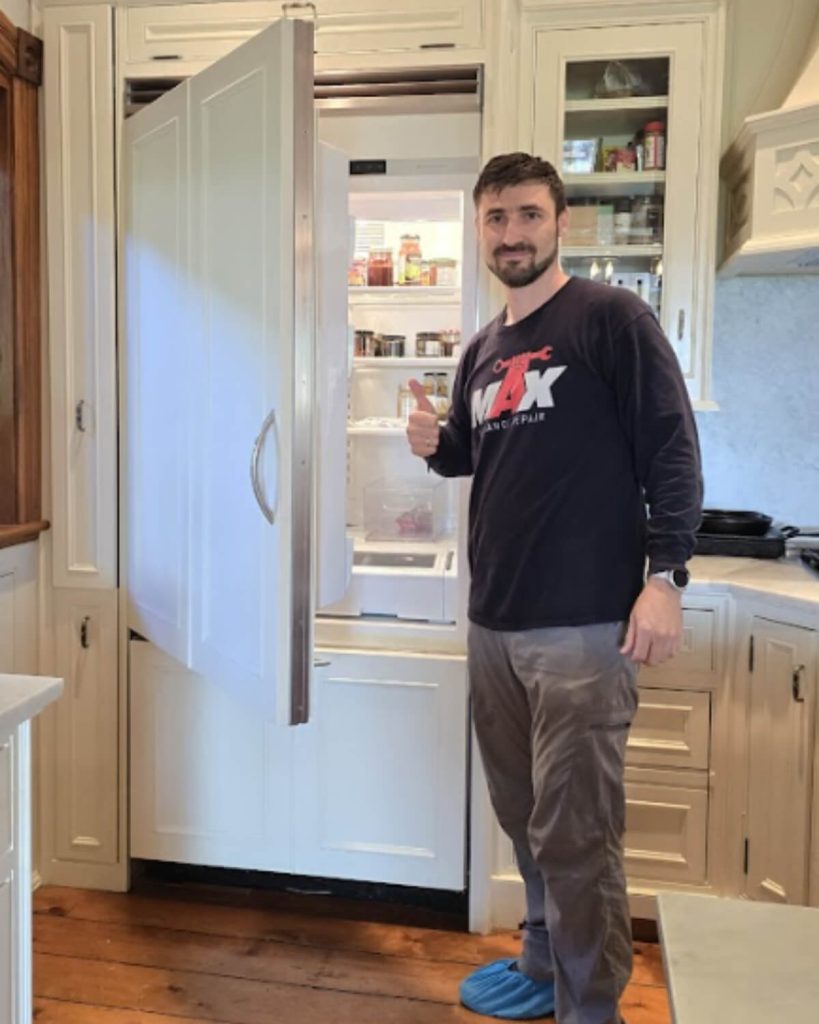
Last updated: August 2026. Reviewed by Maksim Grinvald, owner, Max Appliance Repair Sarasota.
A refrigerator leaking water almost always comes down to one of four things: a blocked defrost drain, a cracked or overflowing drain pan, a loose or split water supply line, or a filter housing that is not sealing. Two of those you can sort out this afternoon. The other two usually need a set of hands under the unit. Where the water lands is the fastest clue, so start there before you pull anything apart.
Below is how to trace a leak from the puddle back to the part that caused it, plus the reason leaks turn into floor damage faster here than they do further north.
In this article
Why is water pooling inside the refrigerator?
Your fridge makes water on purpose. Frost builds on the evaporator coils behind the freezer’s back panel, and every few hours a defrost cycle melts it. That meltwater is supposed to run down a small drain hole into a tube and out to a pan underneath, where the compressor’s heat evaporates it.
When that drain hole clogs with food debris or freezes shut, the water has nowhere to go. It backs up, spreads under the crisper drawers, and eventually spills over the lip and out the front door. Water in the bottom of the fresh food compartment, with dry floor around the unit, is this problem caught early.
- Unplug the fridge and inspect your freezer. The defrost drain is typically located at the bottom back wall of the freezer compartment, directly beneath the evaporator coils (you may need a nut driver or screwdriver to remove the back plastic panel). Once exposed, flush warm water through the drain hole with a turkey baster until it drains freely.
Quick take
Water inside the box and a dry floor points at the defrost drain nearly every time. It is a ten minute job with a turkey baster and no tools.
Why is water leaking onto the kitchen floor?
Water on the floor gets there two ways, and they show up in different places. A puddle that appears at the front, right under the door, is usually the defrost drain again, just further along. A puddle that starts behind the unit and tracks forward is a supply line, a fitting, or the pan.
Pull the fridge out, dry everything with a towel, and watch for twenty minutes. A slow drip you can actually see beats guessing. While you are back there, check the door gasket too. A seal that has stopped gripping lets warm, damp air in, and that air condenses into water that runs down the inside of the door and out onto the floor. Fold a dollar bill in the closed door and pull. If it slides out with no resistance, the gasket is part of your problem.
Did you know
A door that does not seal properly can leave a small puddle every single day without anything actually being broken. In a humid kitchen the air the fridge pulls in carries enough moisture to condense into real water on the inner door panel.
Could the water line or the filter be leaking?
Any fridge with an ice maker or a door dispenser has a plastic or copper line running to it, a shutoff valve, and usually a filter housing. Every one of those is a joint, and joints leak. The line itself can split where it has been kinked behind the unit, or crack near the fitting after years of being pushed against the wall.
The filter head deserves a close look if your leak started soon after a cartridge change. A filter that is not pushed in far enough, a hardened O-ring, or a replacement cartridge that does not quite match the housing will all weep. Pull the cartridge, check the seal is intact and seated, and lock it back in. If water still appears at the housing, the head needs replacing rather than the filter.
Pro tip
Turn the supply valve off for a few hours and see whether the leak stops. If it does, you have narrowed it to the water line, the valve or the filter housing and ruled out the defrost drain entirely.
What about the drain pan under the fridge?
The pan sits under the unit near the compressor and catches everything the defrost cycle melts. Normally the heat coming off the compressor evaporates it as fast as it arrives. A pan that has cracked, worked loose, or been knocked out of position when the fridge was last moved will drip instead.
On older models you can usually slide the pan out from behind the bottom front grille and look at it. On most modern fridges the pan is fixed at the back and is not designed to come out, which is where a service call saves you a broken clip and a bigger leak.
Does Sarasota humidity make refrigerator leaks worse?
It does, in two ways. Damp air pulled through a tired door gasket condenses inside the cabinet, so a marginal seal produces far more water here than the same seal would in a dry climate. And the defrost cycle has more frost to deal with in the first place, which means more meltwater going down a drain that is already narrow.
The second half of the problem is what the water lands on. Tile looks fine and hides what is happening to the subfloor and the cabinet toe-kick underneath. A slow leak that would be a nuisance elsewhere turns into swollen board and mold here, which is why a puddle by the fridge is worth chasing down the same week you notice it.
Symptom to cause, at a glance
Match what you are actually seeing to the likely cause before you take anything apart.
| What you see | Most likely cause | Fix it yourself? | What to do |
|---|---|---|---|
| Water under the crisper drawers | Blocked defrost drain | Yes | Flush the drain hole with warm water |
| Puddle at the front, under the door | Defrost drain overflowing | Yes | Clear the drain, then dry and watch |
| Water at the back of the unit | Supply line, valve or fitting | Sometimes | Shut the supply valve and check for a drip |
| Leak started after a filter change | Filter not seated or bad seal | Yes | Reseat the cartridge, inspect the O-ring |
| Steady drip near the compressor | Cracked or displaced drain pan | No | Have the pan inspected and replaced |
| Damp inner door, water down the front | Failing door gasket | Sometimes | Clean the seal, test it with a dollar bill |
| Ice sheet on the freezer back panel | Defrost system fault | No | Have the heater, timer and sensor tested |
What can I fix myself, and what should I hand over?
Flushing a defrost drain, reseating a filter, cleaning a door gasket and checking a shutoff valve are all reasonable jobs for a homeowner with a towel and an afternoon. They cover most leaks.
Hand over anything that means getting behind the panel or under the chassis: a fixed drain pan, a split supply line inside the door, a failing water inlet valve, or a defrost system that has iced over the coils. Those involve moving a heavy unit, working near a live water line, and knowing which clips break if you pull them the wrong way.
Red flag: water near power
If water has reached the outlet, the power cord, or the compartment where the compressor sits, cut the power at the breaker before you start mopping. Dry the area completely before the fridge goes back on.
If the leak keeps coming back after you have cleared the drain, or you cannot tell where the water is coming from at all, our Sarasota refrigerator technicians trace leaks as part of a standard diagnostic and carry the common seals, valves and lines on the truck. For the temperature and efficiency side of keeping a refrigerator healthy, the ENERGY STAR refrigerator guidance is a good non-commercial reference.
Frequently Asked Questions
A leak is one of the few refrigerator faults that gets more expensive the longer you leave it, because the damage happens to your floor rather than the appliance. Clear the drain, check the filter and the gasket, and watch for a day. If the puddle comes back, book a technician for your refrigerator and we will find the source before the subfloor does.
Need a hand with this one? Max Appliance Repair Sarasota covers Sarasota and Manatee County seven days a week, 7 AM to 10 PM. See refrigerator repair in Sarasota or call (941) 200-1092 and we will book the next opening.
