

Last updated: August 2026. Reviewed by Maksim Grinvald, owner, Max Appliance Repair Sarasota.
If your oven has power but isn’t heating up the short answer is this: power reaching the display does not mean power is reaching the part that actually makes heat. The clock, lights, and fans run on a low-voltage circuit. The heating elements pull from a separate high-voltage line, and that is usually where the fault hides. Our Sarasota oven and range technicians see this exact split almost every week.
Below is how to read the symptoms yourself, which parts fail most often, and where the line sits between a safe check and a call to a licensed pro. If you smell gas, do not operate switches, breakers, plugs or the appliance. Leave immediately and call the gas utility or emergency services from outside.
In this article
Why power to the panel does not mean heat
Modern ovens run two electrical worlds under one door. Electric ranges commonly use 240V for heating elements and 120V for controls. Gas ranges commonly use 120V for controls and ignition. That 120-volt control circuit is why your clock still glows and the buttons still beep. Heat is a different job, requiring high voltage or high amperage to operate the heating elements or fire the igniter.
So when the front looks alive but the food stays raw, the fault is almost always downstream of the control board: a burned-out element, a failed igniter, a tripped safety, or a relay that no longer closes. A working panel is actually good news. It tells you the appliance has power at the wall and the control side is fine, which narrows the search fast. If your oven has power but is not heating, a lit control panel does not prove that the heating circuit is working. Narrowing down which heating component has failed is the next step toward an accurate repair.
Quick take
A glowing display with no heat points to the heating circuit, not the wall outlet. That usually means a bad element, a weak igniter, or a control-board relay, not a dead oven.
What to check before you call anyone
Run through these before anything else. Half the no-heat calls we take in Sarasota turn out to be a setting or a recent power event, not a broken part. Note: If gas is smelled at any point, stop the inspection, leave the building and call the gas utility from outside.
- Confirm the mode. Make sure a delay-start or timed-bake program is not holding the oven off, and that the panel is not stuck in a demo or Sabbath mode.
- Rule out a partial power loss. After a summer storm or a flipped breaker, an electric oven can keep 120 volts for the display but lose one leg of the 240-volt supply, so heat never comes.
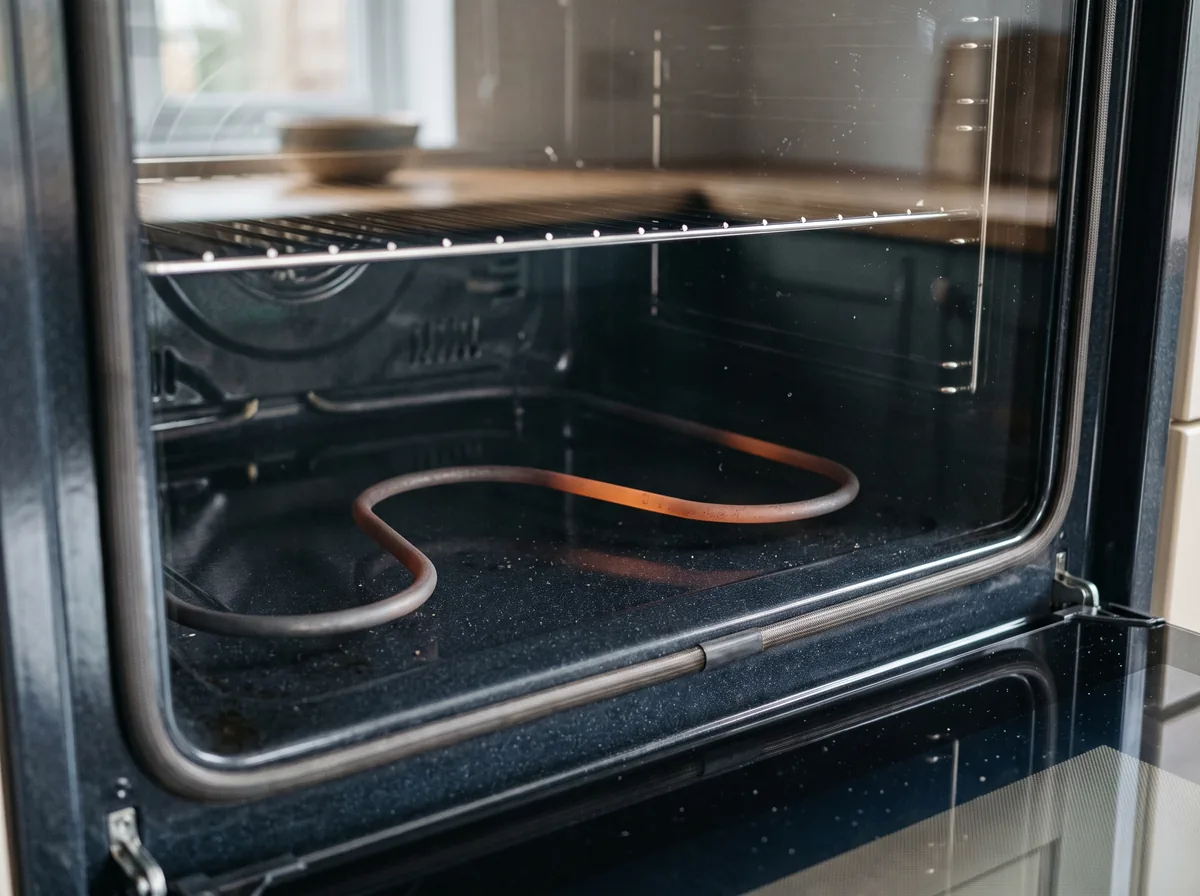
- Watch the bake element. On an electric oven, set it to bake and look through the door. A healthy element glows solid orange within a couple of minutes. Dark spots, blisters, or a visible break mean it is done.
- Look for ignition on a gas oven. You should see the hot surface igniter glow bright orange for 30 to 60 seconds, followed by the ‘whoosh’ of the burner lighting. A long, steady glow with no flame usually means the igniter is too weak to open the gas valve.
- Check for a recent self-clean cycle. High-heat cleaning can blow a thermal fuse, which then blocks normal baking even though the panel still works.
Did you know
A self-clean cycle runs the cavity past 800 degrees Fahrenheit. That heat is the single most common reason an oven quits heating right after cleaning: it trips a one-time thermal fuse designed to protect the electronics. The panel keeps working, but the bake circuit stays locked out until the fuse is replaced.
The parts that fail most often
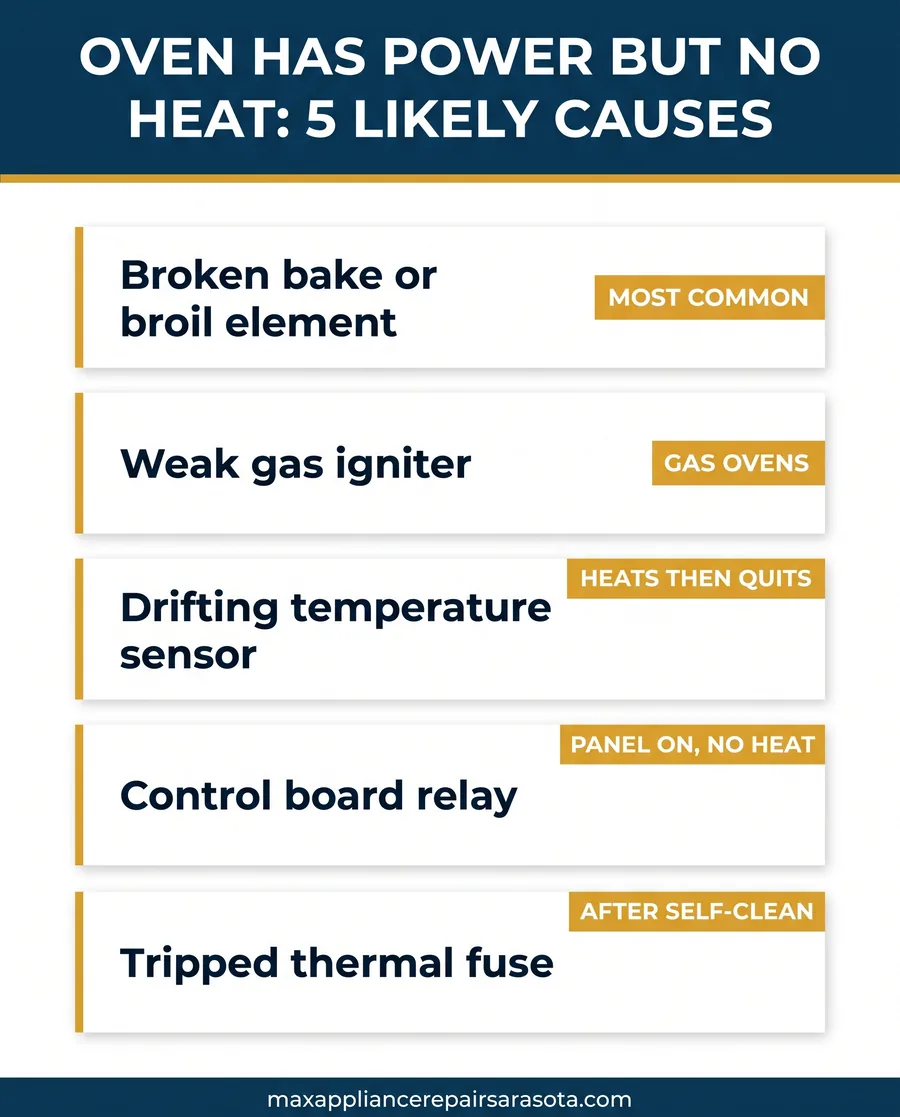
When your oven has power but is not heating, the culprit is usually one of a short list of components. Knowing which one saves you time and tells you whether this is a same-day fix or a part-order job.
- Bake or broil element (electric). The most common failure by far. Elements burn through over years of thermal cycling. A break stops the heat but leaves the rest of the oven fully lit.
- Igniter (gas). On a gas oven, the igniter both lights the gas and tells the safety valve to open. As it weakens with age it glows but no longer draws enough current to open the valve, so you get a glow and no flame.
- Bake temperature sensor. A drifting sensor can make the control board think the oven is already hot, so it never fires the element. This often shows up as an oven that heats a little, then quits.
- Control board relay. The board switches the heating circuit through relays. A failed relay leaves the panel working while the heat circuit never closes.
- Thermal fuse or thermostat. A safety device that has tripped, often after a self-clean cycle, will cut heat while leaving the display alive.
Pro tip
Before you assume the worst, note whether the oven fails cold every time or only after it has been running a while. A dead-cold oven usually points to an element or igniter. One that heats then quits points more often to a sensor or a thermostat drifting out of range. That single detail helps a technician arrive with the right part.
Electric and gas ovens fail differently
The no-heat symptom looks the same from the kitchen, but the cause splits cleanly by fuel type. Electric ranges commonly use 240V for heating elements and 120V for controls, whereas gas ranges commonly use 120V for controls and ignition. This table lines up the usual suspects so you can match what you are seeing to the likely part. It is a starting point for diagnosis, not a repair guide.
| What you notice | Likely cause (electric) | Likely cause (gas) | What to check |
|---|---|---|---|
| Panel on, no heat at all | Broken bake element | Weak or dead igniter | Watch for the element glow or the igniter glow-then-light |
| Broils but will not bake | Failed bake element | Bake igniter fault | Test bake versus broil separately |
| Heats then shuts off | Drifting temp sensor | Failing safety valve | Note how long before it quits |
| Dead after a self-clean | Tripped thermal fuse | Tripped thermal fuse | Confirm a recent clean cycle |
| Uneven or slow heat | Aging element or sensor | Partly clogged burner ports | Compare set temp to an oven thermometer |
For a sense of how a well-maintained oven should perform over its life, the ENERGY STAR appliance guidance is a solid reference on efficiency and expected service life. If your oven is well past a decade and the repair is a major component, it is worth weighing against replacement.
When to stop and call a technician
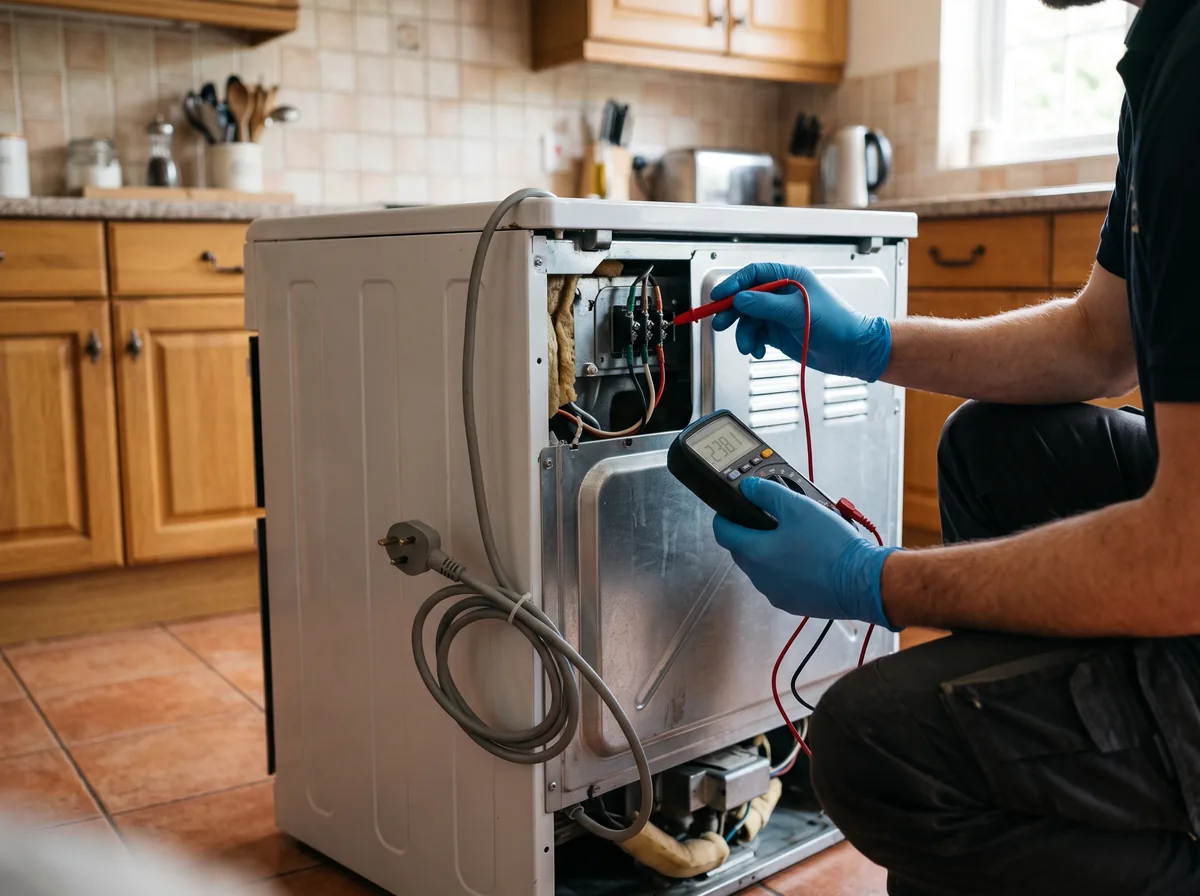
Some no-heat situations are safe to poke at. Others are not. Draw a hard line at anything involving gas, high-voltage wiring, or a burning smell. The cost of a service call is small next to the cost of a fire or a shock, and a good technician arrives with a meter, the right parts, and the training to test a live circuit safely. If your oven has power but is not heating and simple visual checks haven’t revealed the cause, professional testing is the safest way to identify whether the issue is the element, igniter, sensor, thermal fuse, or control board.
Red flag: stop and leave
If you smell gas, do not operate switches, breakers, plugs or the appliance. Leave immediately and call the gas utility or emergency services from outside. If you see scorched or melted wiring, notice sparks when the element energizes, or find the outlet or cord hot to the touch, shut off power at the breaker safely (provided no gas is present) and call a technician.
If the checks above did not reveal an obvious setting or a recent self-clean trip, the next step is a proper diagnosis. Our team covers greater Sarasota and can test the element, igniter, sensor, and control board in one visit. Start at our whole-home appliance service in Sarasota to see what we cover, or read on for the common questions homeowners ask us.
Download the free quick guide
A one-page checklist to safely narrow down why your oven has power but will not heat before you call.
Frequently Asked Questions
Need a hand with this one? Max Appliance Repair Sarasota covers Sarasota and Manatee County seven days a week, 7 AM to 10 PM. See oven repair in Sarasota or call (941) 200-1092 and we will book the next opening.
