


Last updated: August 2026. Reviewed by Maksim Grinvald, owner, Max Appliance Repair Sarasota.
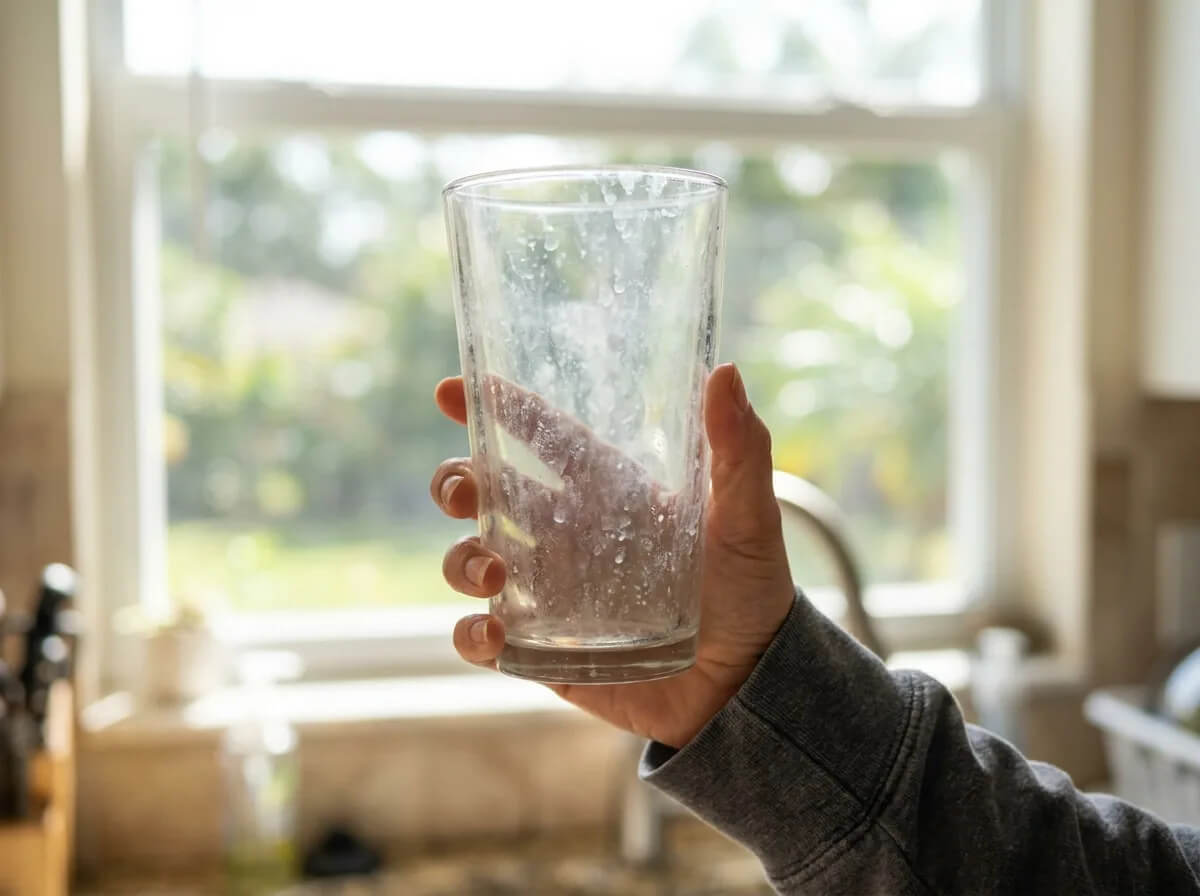
You pull a glass out of the cycle, hold it up to the light, and the surface looks like the morning fog over Sarasota Bay. If your dishwasher leaves film on glasses after every wash, the cause is almost never the dishwasher itself. It is the water, the rinse aid, the detergent, or the temperature, and you can usually fix it without a single tool. Our team fixes dishwashers across Sarasota every week, and the same five causes show up nearly every time.
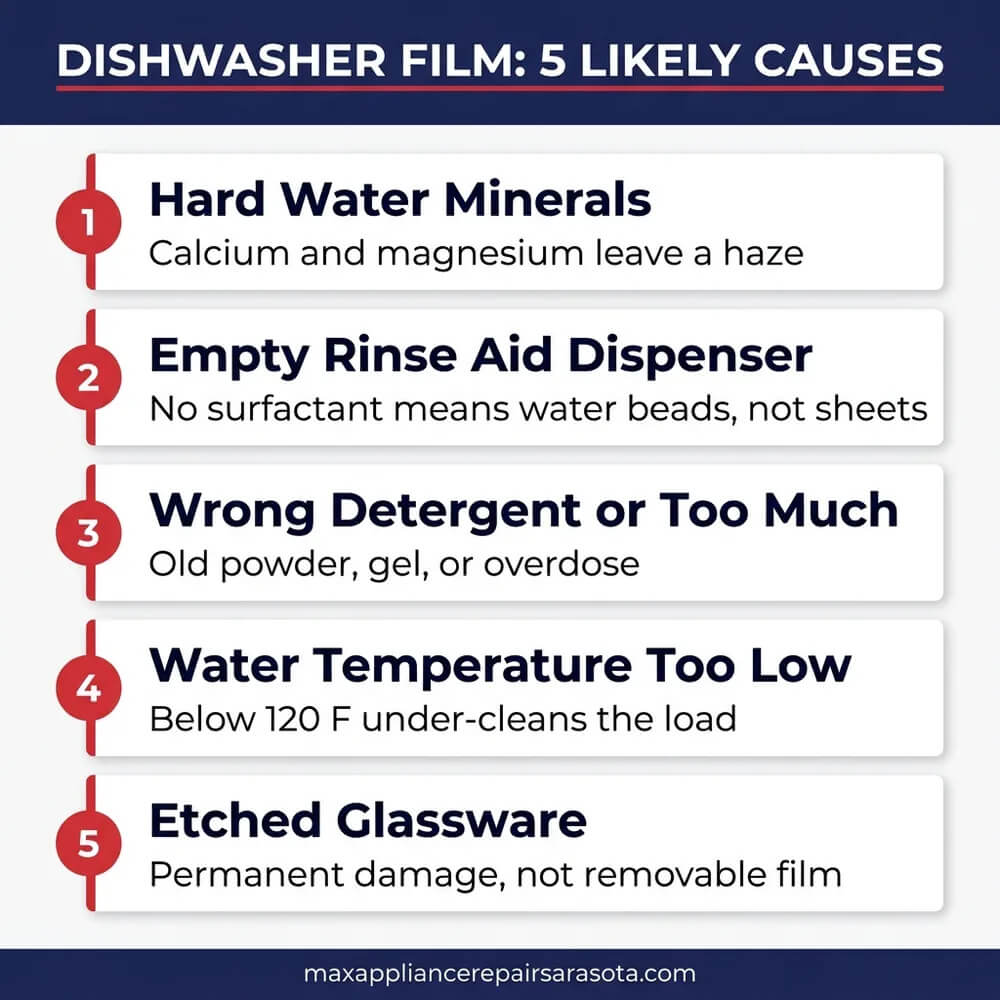
This article walks you through how to tell removable film from permanent etching, the five causes ranked by how often they actually solve the problem in our area, and a 30-minute reset that handles most cases.
In this article
Sarasota’s Hard Water is the Cause
Most homes in our city run on water that ranges from moderately hard to very hard. The dishwasher heats that water, sprays it across your glassware, then evaporates it. The calcium and magnesium that were dissolved in the water do not evaporate, they precipitate out as a thin white film that clings to whatever surface they were on at the moment the water flashed off. Glass shows it the most because glass is smooth and reflective. Plastic and stoneware hide it.
You can confirm hard water in 30 seconds. Fill a clean clear glass with tap water from your kitchen sink. Add three drops of plain dish soap. Cap it with your hand and shake. Soft water foams up immediately and the foam stays. Hard water either does not foam at all, or the foam collapses inside ten seconds and the water turns slightly cloudy. If your test result is the second one, hard water is at least part of your problem.
People often ask: how hard is our water exactly?
It depends on which utility delivers your water. Water is typically in the 7 to 10 grain per gallon range, which is rated hard. Well water in unincorporated areas around Myakka and out toward Lakewood Ranch can run higher than 15 grains per gallon, which is very hard. The United States Geological Survey water hardness scale is the same one most water utilities reference.
Empty or Skipped Rinse aid Dispenser
Rinse aid is the single most underused product in American kitchens, and the single biggest factor in how glasses come out of a dishwasher in hard water. It is not a polish. It is a surfactant that breaks the surface tension of water on the glass surface, so water sheets off rather than beading up and drying in place. When water beads, every bead leaves a mineral spot. When water sheets, the spots have no chance to form.
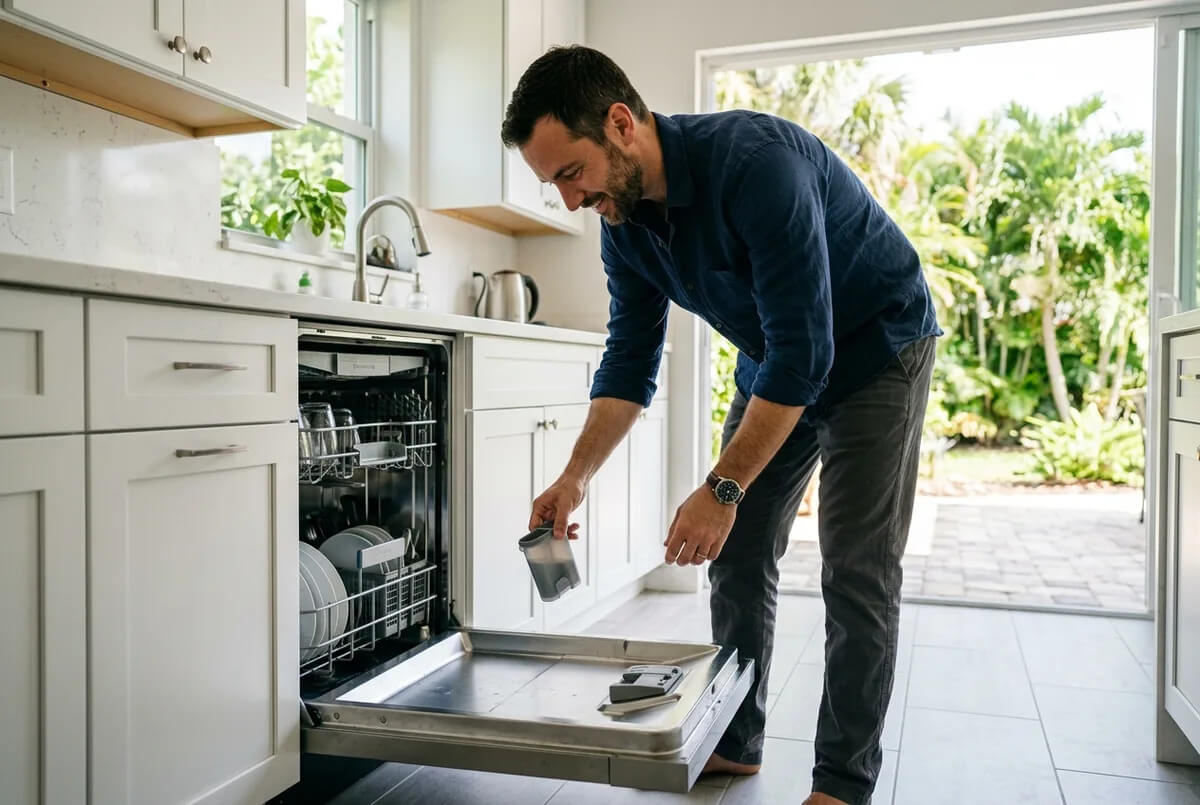
Pop the cap on the rinse aid dispenser, the small round door on the inside of your dishwasher door, near the detergent cup. Most homes find it empty. Refill it with any major brand, the formulas are nearly identical. Set the adjustment dial to 4. Most dishwashers ship from the factory set to 2, which is not calibrated for our hard water in mind.
Pro tip
A bottle of rinse aid lasts most homes about three months at setting 4. Set a calendar reminder, or look at the dispenser through the small window every time you load the dishwasher. The window will turn dark when the level drops below the line. A dispenser that runs dry mid-cycle is the most common reason someone says rinse aid did not work for them.
Wrong Detergent, old Detergent, or too much
Powder dishwasher detergent has a shelf life of about six months in Florida humidity. Past that, the enzymes that do the actual cleaning have broken down and the powder absorbs moisture from the air, which turns the box into a brick. If your detergent has lumps or smells faintly chemical and stale, throw it out and start fresh.
Pods are more stable, but they can fail too. A pod that arrived in a hot August delivery and sat in your pantry for a year often will not dissolve fully on a short cycle. The undissolved fragment leaves a film that looks identical to mineral film. If you find pod residue stuck to the bottom of the dispenser cup after a cycle, the pod did not melt in time. Switch to a fresh box, or run a longer cycle.
Using too much detergent is also a real problem in soft-to-medium water. Excess detergent leaves a film because there is not enough soil in the load to bind to it, and what remains dries onto the glassware. Lightly soiled loads need less detergent, not more.
Water Temperature Below 120 Degrees
Most dishwasher detergents are formulated to activate at 120 degrees Fahrenheit or higher. Below that, the enzymes do not engage, the food residue does not lift, and the rinse aid does not spread. The incoming water from your hot tap is what the dishwasher uses on the first fill, the heater inside the unit just maintains temperature, it does not bring 70-degree water up to 130.
Two checks. First, set your water heater to 120 degrees, which is the temperature recommended by the United States Department of Energy guidelines for water heating. Second, run the kitchen tap on hot for 30 seconds before starting the dishwasher. That flushes the cold water sitting in the pipe and lets the dishwasher start with hot water on the first fill, rather than waiting for the in-unit heater to warm up cold water mid-cycle.
Save your money
A free fix that solves a surprising number of cases. Run hot kitchen tap water for 30 seconds before pressing start. Costs nothing. Adds no time to your day. Eliminates the under-temperature first fill that is the difference between a clean glass and a cloudy one.
Permanent Etching vs Removable Film
Before you replace anything or call anyone, find out which problem you actually have. Mineral film comes off. Glass etching does not. Etching happens when high-temperature, low-mineral, alkaline wash water literally chemically attacks the surface of the glass over hundreds of cycles. The damage is microscopic pits that scatter light. There is no reversing it.
Use this quick check.
| Test | Removable film | Permanent etching |
|---|---|---|
| Vinegar soak (10 min) | Cloudiness clears | Still cloudy |
| Wet finger rub | Wipes off | Stays |
| Pattern under bright light | Cloudy haze, even | Rainbow sheen, micro-pits |
| Reversible | Yes | No, glassware needs replacement |
If a vinegar soak does not clear the cloudiness, you are looking at etching, not film. The bad news is that those glasses are done. The good news is that the conditions that caused the etching, often soft water plus a powerful detergent on a high-temperature cycle, are easy to change going forward. Use less detergent on lightly soiled loads, run an Auto cycle instead of Heavy, and skip the heated dry option where possible.
Did you know?
Some commercial dishwashers in Sarasota restaurants run a built-in water softener cartridge specifically because hard water film is a constant complaint in the food service business. If you run a commercial kitchen and want help with a unit that started leaving residue, talk to our team about commercial-grade dishwasher service. The fix is usually a softener swap, not a unit replacement.
30-minute Reset Solves Most Cases
If you do not want to read the rest of this and just want to clear the film tonight, here is the order. It takes about half an hour and works for the majority of homes we visit.
- Empty the dishwasher and pull out both racks. Wipe the door gasket with a damp cloth. Look for any visible food fragments around the drain at the bottom and pull them out by hand.
- Twist off the lower spray arm and run hot water through it. If any of the small spray holes are clogged with mineral scale, work them clear with a toothpick. Do the same on the upper arm if it pops off easily.
- Refill the rinse aid dispenser to the line. Set the adjustment dial to 4. If the dial sits behind the dispenser cap, look for a small notch you turn with a coin.
- Pour one cup of plain white vinegar into a dishwasher-safe bowl and place it upright on the top rack. Do not add any detergent.
- Run the kitchen sink on hot for 30 seconds, then start the dishwasher on the hottest cycle available with the heated dry option turned off.
- When the cycle finishes, replace the detergent with a fresh box if yours is more than 6 months old. Run a normal load with the new detergent and inspect a glass against window light. The cloudiness should be visibly better, often gone.
Quick diagnostic: which fix do I need first?
Take this with you
A printable, one-page checklist of the 30-minute reset, plus a quick reference for hard water settings.
Download the dishwasher film fix-it checklist (PDF)Final Thoughts
Cloudy glasses are frustrating, but in most cases, the fix is simple once you know what to look for. Hard water, rinse aid, detergent, and temperature all play a role, and small adjustments can make a big difference. Start with the quick reset, then fine-tune your routine as needed. If the film still won’t budge, it may be time to look closer. Either way, clear glassware is usually just a few changes away.
Frequently asked questions
Is the white film on my glasses safe?
If the film wipes off with vinegar or rubs off with a paper towel, yes. It is calcium and magnesium minerals from your water plus dried detergent or food residue. Once you fix the underlying cause, your glasses will go back to clear. The mineral deposits themselves are harmless to drink, the same minerals are in every glass of water you pour.
What is the difference between film and etching?
Film wipes off. Etching does not. To check, soak a cloudy glass in white vinegar for ten minutes, scrub it, and rinse. If the cloudiness is gone, it was film and you can prevent it. If the glass is still hazy after vinegar, the surface has been chemically etched by years of high-temperature low-mineral wash water. Etching is permanent, the only fix is replacement.
Will a water softener fix this?
Almost always, yes. Whole-home water softeners pull calcium and magnesium out of the water before it reaches any appliance. Most homeowners notice a difference in glassware within two cycles. Softeners also extend the life of your dishwasher, water heater, and ice maker by reducing scale. Salt-free conditioners and template-assisted crystallization units help less, the magnetic descalers sold online help essentially not at all.
Should I run an empty cycle with vinegar to clean my dishwasher?
Yes, every two months in our water. Pour one cup of plain white vinegar into a dishwasher-safe bowl on the top rack and run a hot cycle with no detergent. Once a year, also pull the lower spray arm off (it twists or unscrews) and soak it in vinegar to clear the spray jets. A dishwasher with clean spray arms and a fresh fill of detergent does most of the work the manufacturer expects of it.
My new glasses came out cloudy after one wash, is the dishwasher broken?
Probably not. New glassware sometimes has a fine factory residue that bonds with hard water on the first cycle. Hand-rinse new glasses once before their first dishwasher run, and use the rinse aid dispenser. If the cloudiness still appears on every cycle after that, work through the five causes in this guide. The dishwasher itself is rarely the underlying issue.
Hard water is the usual culprit, and rinse aid plus a vinegar cycle fixes most of it. If the film survives all five fixes, get your dishwasher looked at by our Sarasota team and we will check the heater, the spray arms and the fill valve.
Need a hand with this one? Max Appliance Repair Sarasota covers Sarasota and Manatee County seven days a week, 7 AM to 10 PM. See dishwasher repair in Sarasota or call (941) 200-1092 and we will book the next opening.
